Training at home does not have to mean focusing only on your legs or doing the same full-body routine every time you exercise. A simple upper body home workout for beginners can help you become familiar with exercises that target your chest, shoulders, arms, upper back, and core while keeping your routine manageable.
You do not need a fully equipped home gym to get started. Many beginner-friendly upper body exercises can be performed using your body weight, a wall, or a stable elevated surface. What matters most is choosing exercises that match your current fitness level and performing them with control.
An upper body workout can also fit easily into an existing weekly routine. For example, you could include it as one of your three weekly workouts or use selected exercises as part of a broader full-body program.
The purpose of this guide is not to create an exhausting workout. Instead, it provides a practical starting point for beginners who want to strengthen and develop their upper body at home.
Why Train Your Upper Body at Home?
Your upper body is involved in many everyday movements.
You use your arms and shoulders when carrying shopping bags, reaching for objects, opening doors, lifting household items, and performing many other ordinary activities.
Regular resistance exercise can help you become more comfortable with these movements while building a foundation of strength.
Training at home also removes some of the barriers that can make exercise difficult to maintain.
You do not have to:
- travel to a gym
- wait for equipment
- spend time setting up complicated machines
- follow an advanced workout program
- purchase expensive equipment before you begin
A small amount of floor space can be enough for many beginner exercises.
Another advantage is that you can adjust the difficulty to your current ability. For example, if a regular push-up is too challenging, you can begin with wall push-ups and gradually progress to an incline version.
This allows you to develop your strength step by step instead of trying to perform an exercise that is currently too difficult.
What Muscles Does an Upper Body Workout Target?
The phrase “upper body” includes several different muscle groups.
A balanced beginner workout can involve the:
- chest
- shoulders
- upper back
- arms
- core
Different exercises place different levels of emphasis on these areas.
For example, push-up variations primarily involve the chest, shoulders, and triceps. Exercises such as bird-dog also involve the core while requiring coordination and stability.
This is one reason why it can be useful to include several different movements instead of repeating only one exercise.
You do not need to isolate every individual muscle in a beginner routine.
Instead, focus on basic movement patterns that allow several muscle groups to work together.
Best Upper Body Exercises for Beginners
There are many upper body exercises available, but beginners do not need dozens of different movements.
A small selection of exercises can provide a useful starting point.
The following exercises can be performed at home with little or no equipment.
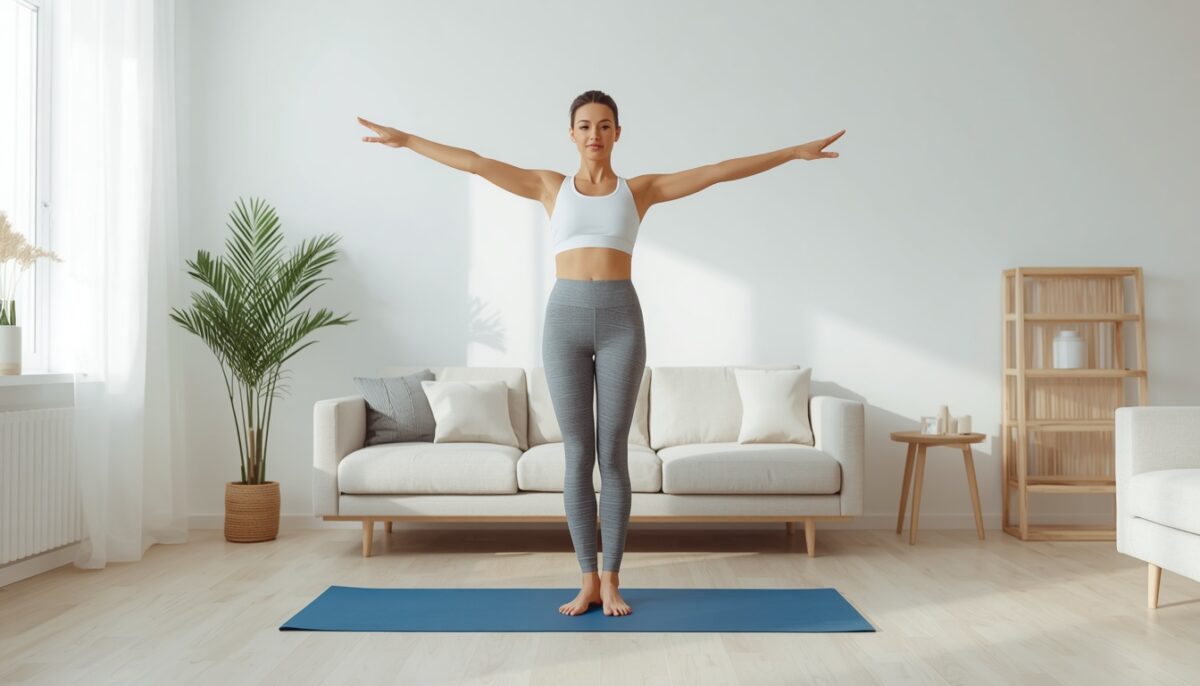
Wall Push-Ups
Wall push-ups are one of the easiest ways to introduce pushing movements into a home workout.
Stand facing a wall and place your hands against it at approximately chest height. Your hands should be slightly wider than your shoulders.
Walk your feet backward until you are standing at a comfortable angle.
Bend your elbows and slowly bring your upper body toward the wall. Keep your body controlled rather than allowing your hips to move forward or backward.
Then push through your hands and return to the starting position.
Beginner target: 8–12 repetitions
If the movement feels too easy, gradually move your feet farther away from the wall.
If you have already been following our beginner workouts, wall push-ups can also be used as a progression toward incline push-ups.
Incline Push-Ups
Incline push-ups provide a more challenging variation while still being easier than a traditional floor push-up for many beginners.
Place your hands on a stable elevated surface such as a sturdy countertop or table.
Step your feet backward and create a straight, comfortable body position.
Slowly bend your elbows and lower your chest toward the surface. Then push yourself back up.
Beginner target: 6–12 repetitions
The surface must be stable and strong enough to support you safely.
Do not use a lightweight chair or unstable piece of furniture for this exercise.
If incline push-ups are too difficult, return to wall push-ups until you become stronger.
Shoulder Taps
Shoulder taps introduce a combination of upper-body support and core stability.
Start in a comfortable high-plank position. If a full plank is currently too difficult, you can perform the movement with your hands on a stable elevated surface.
Slowly lift one hand and tap the opposite shoulder. Return the hand to the starting position and repeat on the other side.
Beginner target: 6–10 taps per side
Move slowly.
The goal is to minimize unnecessary movement through your hips and torso.
If maintaining a stable position is difficult, use an elevated surface or reduce the number of repetitions.
Bird-Dog
Bird-dog is not exclusively an upper body exercise, but it is useful because it combines shoulder movement, arm extension, balance, and core stability.
Start on your hands and knees.
Slowly extend one arm forward while extending the opposite leg backward. Keep your movements controlled.
Return to the starting position and switch sides.
Beginner target: 6–8 repetitions per side
You do not need to extend your arm and leg as far as possible.
Focus on maintaining balance and keeping your body stable throughout the movement.
This exercise can be particularly useful for beginners who are learning how to coordinate upper-body and core movement.
How to Choose the Right Exercise Difficulty
The same exercise can feel very different depending on your current strength and experience.
For example, one beginner may be able to perform incline push-ups comfortably, while another may need to start with wall push-ups.
Neither approach is wrong.
Your starting point should allow you to perform the movement with reasonable control.
A useful progression is:
Wall push-up → Incline push-up → Knee push-up → Standard push-up
You do not have to move through every stage quickly.
Stay with the easier version until you can perform it comfortably and consistently.
The same principle applies to other exercises.
If shoulder taps are too difficult, perform them with your hands on an elevated surface.
If bird-dog feels unstable, move only one limb at a time.
The purpose of a beginner workout is to create a foundation for future progress.
More Beginner-Friendly Upper Body Exercises
The first exercises introduced simple pushing, stability, and coordination movements. You can add a few more exercises to create a more balanced upper body routine.
The goal is still to keep the movements simple and controlled rather than trying to use as many exercises as possible.
Superman
The Superman exercise focuses on the muscles along the back of your body and can be included as part of a beginner home workout.
Lie face down on an exercise mat or another comfortable surface. Extend your arms in front of you and keep your legs comfortably extended.
Gently lift your arms and upper chest while raising your legs slightly from the floor if this feels comfortable.
Pause briefly and then slowly return to the starting position.
Beginner target: 6–10 repetitions
You do not need to lift your arms and legs very high. A small, controlled movement is enough.
If the full movement feels uncomfortable, begin by lifting only your arms or only your legs.
Triceps Dips – Beginner Modification
Triceps dips can be performed at home, but beginners should be particularly careful about stability.
Use a sturdy chair that does not move or slide easily. Sit near the front edge and place your hands beside your body.
For a beginner-friendly version, keep your feet relatively close to the chair and perform only a small lowering movement.
Beginner target: 6–10 repetitions
Do not lower yourself deeply if the movement causes discomfort.
An alternative is to perform a standing triceps extension using a resistance band later in your training journey. If you do not have equipment, you can simply leave this exercise out of the routine.
The goal is to strengthen your upper body, not to force yourself to perform an exercise that does not feel appropriate for your current level.
Arm Circles
Arm circles are a simple movement that can be used during a warm-up or as a light shoulder exercise.
Stand upright with your feet comfortably apart.
Extend your arms out to the sides and make small controlled circles.
After several repetitions, gradually make the circles slightly larger if the movement feels comfortable.
Beginner target: 10–15 circles in each direction
Keep your shoulders relaxed and avoid swinging your arms aggressively.
Arm circles are particularly useful before an upper body workout because they allow you to begin moving your shoulders gradually.
Standing Wall Angels
Wall angels can help you practice controlled shoulder movement and upper-body posture.
Stand with your back against a wall if comfortable. Keep your movements slow as you move your arms upward and then back down.
Try to avoid forcing your shoulders or arms into a position that feels uncomfortable.
Beginner target: 6–10 repetitions
If maintaining contact with the wall is difficult, simply perform a smaller range of motion.
The exercise should feel controlled rather than forced.
Beginner Upper Body Home Workout
Now that you know the basic exercises, you can combine them into a simple routine.
This workout is designed for beginners and does not require a gym.
Before starting, spend about five minutes warming up. You can use easy arm circles, marching in place, shoulder movements, and other gentle movements to gradually prepare your body.
For the main workout, begin with 2 sets of each exercise.
Rest for approximately 45–60 seconds between sets.
Workout Routine
| Exercise | Sets | Repetitions |
|---|---|---|
| Wall or incline push-ups | 2 | 8–12 |
| Shoulder taps | 2 | 6–10 per side |
| Bird-dog | 2 | 6–8 per side |
| Superman | 2 | 6–10 |
| Standing wall angels | 2 | 6–10 |
| Arm circles | 2 | 10–15 each direction |
You do not need to perform every exercise at the highest suggested repetition range.
Choose a number that allows you to maintain good control.
For example, if eight shoulder taps per side are difficult, you can start with five or six. If twelve wall push-ups are easy but your technique remains good, you can gradually increase the challenge.
How to Perform the Workout
The order of the exercises matters less than maintaining good technique, but the following sequence provides a simple structure.
Start with wall or incline push-ups while you are relatively fresh. This allows you to focus on your pushing technique.
Move to shoulder taps and bird-dog to work on upper-body stability and coordination.
Then perform Superman and wall angels to include movements that focus more on the back and shoulders.
Finish with arm circles as a light movement.
Take your time between exercises.
You do not need to turn the workout into a race.
A beginner workout should give you enough time to concentrate on how each movement feels and whether you are maintaining control.
What If You Cannot Do a Push-Up?
This is one of the most common questions beginners have.
You do not need to be able to perform a traditional push-up before starting an upper body workout.
Push-ups can be progressed gradually.
Start with:
Wall push-ups
When these become comfortable, move to:
Incline push-ups
Later, you can try:
Knee push-ups
Eventually, if your strength and technique allow it, you can work toward:
Standard push-ups
There is no deadline for reaching the next stage.
If you can perform an easier variation consistently, that is already useful progress.
Do not compare your starting point with someone else’s.
How to Modify the Workout
Your workout should match your current ability.
If you are completely new to exercise, you may want to begin with one set of each exercise rather than two.
You can also reduce the number of repetitions.
For example:
- Wall push-ups: 6–8 repetitions
- Shoulder taps: 5–6 per side
- Bird-dog: 5–6 per side
- Superman: 5–6 repetitions
- Wall angels: 5–6 repetitions
As you become more comfortable, gradually work toward the recommended ranges.
You can also take longer breaks between exercises.
There is no need to keep your rest periods short if you are still learning the movements.
How Often Should You Perform an Upper Body Workout?
For most beginners, one or two dedicated upper body sessions per week can fit comfortably into a broader exercise routine.
The exact frequency depends on what your other workouts look like.
If you are following our 3-Day Home Workout Plan for Beginners, you can use some of these exercises as part of one of your weekly sessions rather than adding another demanding workout.
You also do not need to train the same muscles intensely on consecutive days.
Give yourself enough recovery time between challenging sessions.
Your overall goal should be a balanced routine that includes exercise, recovery, and normal daily movement.
How to Progress Your Upper Body Workout
Once you become comfortable with the basic exercises, you can gradually make your workouts more challenging.
You do not need to make large changes from one week to the next. Small improvements are usually easier to manage and allow you to concentrate on your technique.
For example, if you currently perform two sets of eight wall push-ups, you could gradually work toward ten or twelve repetitions. When that becomes comfortable, you could move to incline push-ups.
The same principle can be applied to other exercises.
You can progress by:
- increasing the number of repetitions
- adding another set
- using a more challenging exercise variation
- increasing your range of motion
- slowing down the movement
- improving your exercise technique
Try to change only one element at a time.
There is no need to make every workout harder. Your first goal is to become comfortable with the routine and perform the exercises consistently.
When to Move to a More Difficult Variation
A useful sign that you are ready to progress is when an exercise feels controlled and relatively comfortable throughout the recommended repetition range.
For example, if wall push-ups have become easy and you can perform them without losing your body position, you may be ready to try incline push-ups.
You can use a similar progression with other exercises.
Wall push-ups → Incline push-ups → Knee push-ups → Standard push-ups
For shoulder taps, you might begin with your hands against an elevated surface before progressing to a lower surface or eventually the floor.
The important thing is to progress gradually.
You do not need to move to a harder version simply because you have been exercising for a certain number of weeks.
Your current ability is a better guide than an arbitrary deadline.
How Often Should Beginners Train Their Upper Body?
For a beginner, one or two upper-body-focused sessions per week can be enough when combined with other forms of exercise.
If you are already following a three-day workout routine, you do not necessarily need to add separate upper body sessions.
Instead, you can make one of your existing workouts more focused on the upper body while continuing to train your legs and core during the other sessions.
For example:
| Day | Focus |
|---|---|
| Monday | Full body |
| Wednesday | Upper body + core |
| Friday | Full body |
Another option is to include a few upper-body exercises during each full-body session.
The best approach depends on your overall routine, fitness level, and recovery.
More workouts are not automatically better.
Common Upper Body Workout Mistakes
Beginners can make progress much easier when they avoid a few common mistakes.
Trying to Do Standard Push-Ups Too Soon
A standard push-up can be challenging when you are new to exercise.
There is no reason to skip the easier variations.
Wall and incline push-ups allow you to practice the movement while gradually building strength.
Using Unstable Furniture
Home workouts sometimes involve chairs, tables, or countertops.
Make sure anything you use for support is stable before putting your body weight against it.
Do not use furniture that moves easily, folds, or has wheels.
Doing Repetitions Too Quickly
Fast repetitions can make an exercise feel easier because you have less time under control.
Instead, slow the movement down and concentrate on the position of your body.
Quality is more important than simply reaching a high repetition number.
Ignoring Recovery
Your muscles need time to recover between challenging workouts.
If your upper body is still very tired or sore from the previous session, consider giving yourself additional recovery time instead of forcing another demanding workout.
Comparing Your Progress With Other People
Fitness progress is individual.
Someone else may be able to perform more push-ups or use more resistance, but that does not tell you whether your own workout is appropriate.
Track your own progress instead.
Being able to perform an exercise more comfortably than you could a few weeks earlier is meaningful progress.
How to Make Your Home Workout More Effective
You do not need expensive equipment to make a beginner upper body workout useful.
Start by concentrating on consistency and technique.
Make sure you have enough space to move safely and that your exercise surface is comfortable.
It can also help to schedule your workouts in advance.
For example, choose two specific days each week and treat them as regular appointments.
You can also keep a simple record of your workouts.
Write down:
- the exercise
- number of sets
- repetitions
- exercise variation
- how the workout felt
After several weeks, this gives you a simple way to see whether you are becoming stronger or more comfortable with the exercises.
If you want to combine upper-body exercises with a broader routine, our Weekly Home Workout Plan for Beginners can help you organize your training week.
Frequently Asked Questions
Can beginners do an upper body workout at home?
Yes. Many beginner upper-body exercises can be performed at home using body weight, a wall, or a stable elevated surface.
The exercises should be adjusted to match your current ability.
Can I build upper body strength without weights?
Bodyweight exercises can provide resistance and can be useful for beginners.
Push-up variations, shoulder taps, bird-dog, and other controlled movements can form part of a beginner routine.
As you become stronger, resistance bands or dumbbells can provide additional options.
How many times a week should I train my upper body?
One or two upper-body-focused sessions per week can fit into a beginner routine.
Remember that your overall workout schedule also matters. You do not need to train your upper body intensely every day.
What should I do if an exercise causes pain?
Stop the exercise if it causes pain rather than ordinary exercise effort.
Try an easier variation or leave the movement out of your workout.
If you have an injury, medical condition, or concerns about whether exercise is appropriate for you, speak with a qualified healthcare professional before starting or changing your exercise routine.
How long should an upper body home workout last?
A beginner session can be relatively short.
A workout of around 20–30 minutes, including a warm-up and cool-down, can provide enough time to complete the basic routine without making exercise unnecessarily time-consuming.
Can I combine this workout with my other home workouts?
Yes. This routine can be incorporated into a broader weekly program.
For example, you can use it as the upper-body-focused part of a three-day routine rather than treating it as an additional workout.
Our 3-Day Home Workout Plan for Beginners provides an example of how three weekly workouts can be organized.
Final Thoughts
An upper body home workout for beginners does not need to be complicated.
You can start with simple movements such as wall push-ups, incline push-ups, shoulder taps, bird-dog, Superman, and wall angels. As you become more comfortable, you can gradually increase repetitions, add sets, or move to more challenging variations.
The most important part is creating a routine that you can maintain.
You do not need to perform advanced exercises or spend hours training. Start at a level that feels manageable, concentrate on controlled movements, allow enough time for recovery, and gradually build from there.
If you are new to home exercise, our Home Workouts for Beginners: Complete Guide to Getting Started is a useful place to review the basics of creating a sustainable workout routine.
Related Articles
- Home Workouts for Beginners: Complete Guide to Getting Started
- 10-Minute Home Workout for Busy People
- Best Home Workout Without Equipment (Complete Beginner Guide)
- Weekly Home Workout Plan for Beginners
- Best Warm-Up Exercises Before a Home Workout
- How to Stay Motivated to Exercise at Home
- Lower Body Home Workout for Beginners