If you want to strengthen your legs and build a more balanced fitness routine, a lower body home workout for beginners is a simple place to start. You do not need a gym membership or complicated equipment to train your legs, glutes, and hips effectively.
A beginner-friendly lower body workout should focus on basic movements that are easy to understand and modify. Exercises such as squats, glute bridges, reverse lunges, and calf raises can help you develop strength while allowing you to gradually become more comfortable with exercise.
The goal is not to complete as many repetitions as possible. Instead, focus on controlled movements, good technique, and consistency.
If you are completely new to home workouts, start with our Home Workouts for Beginners: Complete Guide to Getting Started, where you can learn the basics of creating a safe and sustainable exercise routine at home.
Important: This article is intended for general fitness information. If you have an injury, medical condition, or persistent pain, speak with an appropriate healthcare professional before starting a new exercise program. Stop an exercise if it causes sharp or unusual pain.
Why Train Your Lower Body at Home?
Your lower body performs a large amount of work during everyday activities. Walking, climbing stairs, standing up from a chair, and getting out of a car all require your legs and hips to work together.
You do not need to train like an athlete to benefit from stronger lower-body muscles. For beginners, simple exercises performed consistently can help build a useful foundation.
Lower body training can also complement upper body workouts and help you create a more balanced fitness routine.
Benefits of Lower Body Training
Regular lower body exercise can help you:
- strengthen the muscles of your legs
- develop stronger glutes
- improve lower-body endurance
- make everyday movements feel easier
- improve balance and stability
- develop better control of basic movement patterns
- build confidence with exercise
- create a more balanced home workout routine
For beginners, one of the biggest benefits is learning how your body responds to exercise. Movements that initially feel difficult can become easier as your strength and coordination improve.
What Muscles Does a Lower Body Workout Target?
A beginner lower body workout can involve several major muscle groups. You do not need to isolate every muscle individually because many basic exercises work several muscles at the same time.
Quadriceps
The quadriceps are located at the front of your thighs. They are involved when you straighten your knees and are particularly active during movements such as squats and lunges.
Glutes
The gluteal muscles are located around the hips and buttocks. They play an important role in movements involving hip extension, such as standing up, climbing stairs, and performing glute bridges.
Hamstrings
The hamstrings are located at the back of the thighs. They work together with the glutes and other muscles around the hips and knees during many lower-body movements.
Calves
The calf muscles are located at the back of the lower legs. They are involved when you raise your heels from the floor, making calf raises a simple exercise for beginners.
Core and Stabilizing Muscles
Although the main focus is the legs and hips, your core also works during many lower-body exercises. Your abdominal and stabilizing muscles help you maintain posture and control while performing movements such as squats and lunges.
Best Lower Body Exercises for Beginners
You do not need dozens of exercises to create an effective beginner workout. A small selection of simple movements is enough to start building strength.
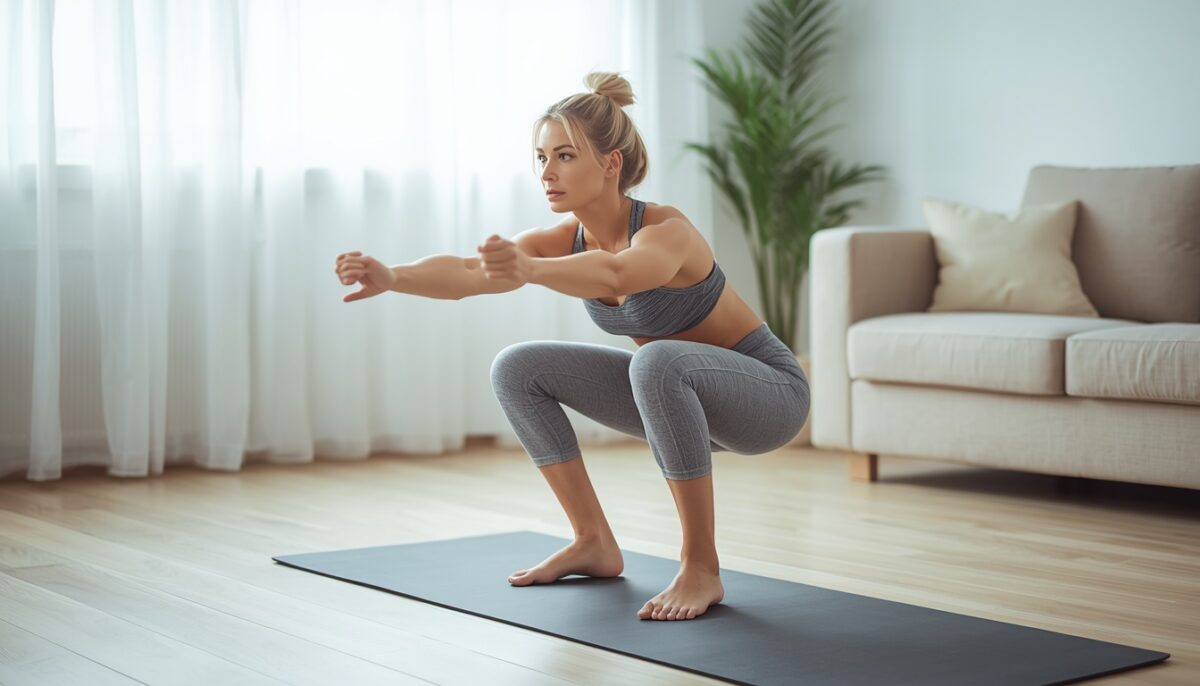
Bodyweight Squats
The bodyweight squat is one of the most useful lower-body exercises for beginners. It teaches a movement pattern you already use in everyday life: lowering your body and then standing back up.
How to perform a bodyweight squat:
- Stand with your feet approximately shoulder-width apart.
- Keep your chest comfortably upright.
- Brace your core gently.
- Push your hips backward as if you were sitting into a chair.
- Lower yourself only as far as you can comfortably control.
- Push through your feet to return to standing.
- Repeat slowly and with control.
You do not need to squat very deeply when you are starting. Your range of motion can improve gradually.
Beginner starting point:
Try 2 sets of 8–10 repetitions.
If regular squats feel difficult, you can use a stable chair as a reference point.
Glute Bridges
Glute bridges can be performed on the floor and are a beginner-friendly way to train the muscles around the hips and buttocks.
How to perform a glute bridge:
- Lie on your back on an exercise mat.
- Bend your knees and place your feet flat on the floor.
- Keep your arms relaxed beside your body.
- Gently brace your core.
- Press through your feet and raise your hips.
- Pause briefly at the top.
- Lower your hips slowly.
- Repeat.
Avoid using momentum. Keep the movement controlled.
Beginner starting point:
Try 2 sets of 10–12 repetitions.
Reverse Lunges
Reverse lunges can challenge both strength and balance. For some beginners, stepping backward feels easier to control than stepping forward.
How to perform a reverse lunge:
- Stand upright with your feet comfortably apart.
- Step one leg backward.
- Bend both knees in a controlled manner.
- Lower your body only as far as comfortable.
- Push through the front foot to return to standing.
- Bring your feet together.
- Repeat on the opposite side.
If your balance is limited, perform the exercise near a stable surface for light support.
Beginner starting point:
Try 6–8 repetitions per leg.
Calf Raises
Calf raises require very little space and no equipment.
How to perform calf raises:
- Stand upright with your feet about hip-width apart.
- Keep your posture comfortable.
- Slowly raise your heels from the floor.
- Pause briefly at the top.
- Lower your heels in a controlled manner.
- Repeat.
If balance is an issue, perform the exercise near a wall.
Beginner starting point:
Try 2 sets of 10–15 repetitions.
How to Choose the Right Difficulty
One of the biggest mistakes beginners make is assuming that a harder exercise is automatically better.
The best starting exercise is one that you can perform with reasonable control and without pain.
If a full squat is difficult, reduce the depth or use a supported variation. If reverse lunges are too challenging, use a smaller step or hold onto a stable support.
A useful rule is:
Start easier than you think you need to, then progress gradually.
Consider making an exercise easier if:
- you cannot maintain control
- your technique changes significantly during the set
- you have to rush the repetitions
- you repeatedly lose your balance
- you cannot complete the exercise safely
- you feel sharp or unusual pain
Muscular effort can be challenging, but sharp or unusual pain should not be ignored.
Beginner Lower Body Home Workout
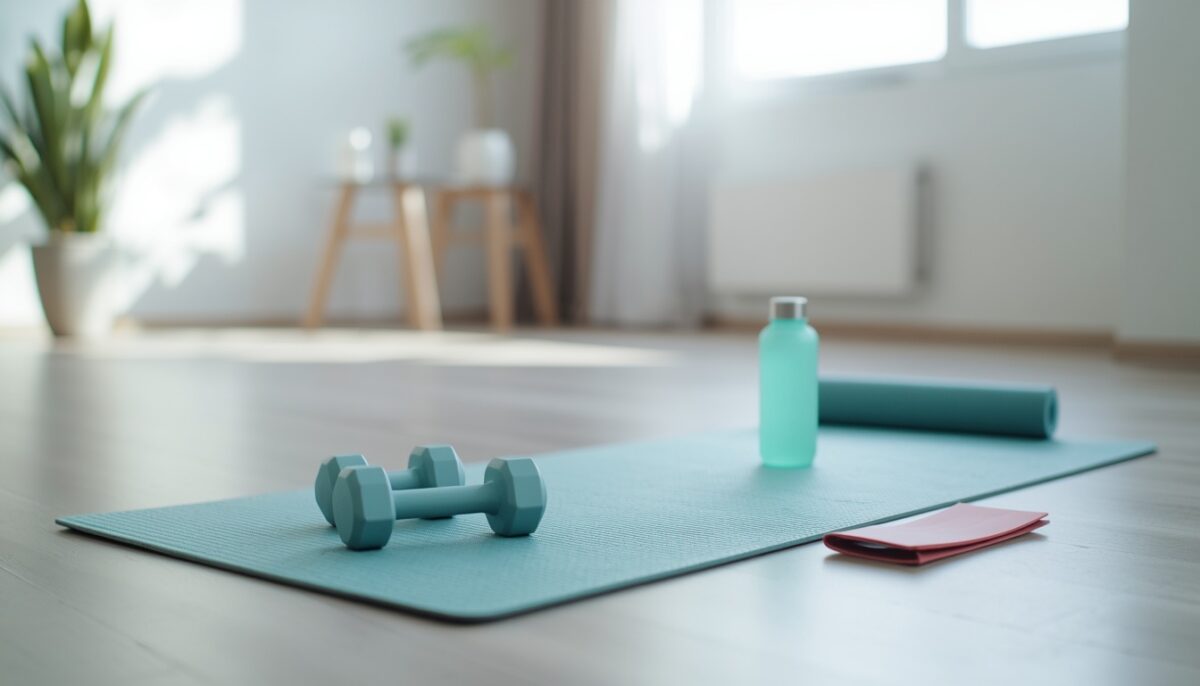
Now you can combine the exercises into a simple workout.
You can perform this routine at home with an exercise mat and enough space to move safely.
Beginner Workout Structure
- Bodyweight squats – 8–10 repetitions
- Glute bridges – 10–12 repetitions
- Reverse lunges – 6–8 repetitions per leg
- Calf raises – 10–15 repetitions
- Rest – 60–90 seconds
- Repeat the circuit 2 times
If you are completely new to exercise, start with one round. You can move to two rounds when the routine becomes easier.
How to Perform the Workout
Before starting the main workout, spend a few minutes preparing your body.
A short warm-up can include easy walking around the room, gentle leg movements, and controlled arm movements.
For more detailed guidance, see our Best Warm-Up Exercises Before a Home Workout.
Start with bodyweight squats, followed by glute bridges, reverse lunges, and calf raises. Keep your repetitions controlled and rest whenever you need to.
You do not need to rush through the workout.
A beginner session should leave you feeling that you completed useful work without completely exhausting yourself.
How to Modify the Workout
Not every beginner starts at the same fitness level. You may find that squats are easy while lunges are difficult. That is completely normal.
Adjust individual exercises rather than abandoning the entire workout.
Make Squats Easier
If regular squats feel difficult:
- reduce the depth
- perform fewer repetitions
- use a stable chair as a reference
- take longer rest periods
Make Lunges Easier
If reverse lunges are challenging:
- take a shorter step
- reduce the depth
- hold a stable support
- perform fewer repetitions per leg
- move more slowly
Make Glute Bridges Easier
If glute bridges feel difficult, reduce the number of repetitions and concentrate on controlled movement.
Make sure you are using a comfortable exercise mat or another safe surface.
Make Calf Raises Easier
If you have difficulty maintaining balance, perform calf raises next to a wall or another stable support.
Use the support for balance rather than pulling yourself upward with your arms.
How Often Should You Do a Lower Body Workout?
Beginners do not need to train their lower body every day.
A practical starting point for many beginners is two lower-body sessions per week, with enough recovery between sessions.
You can also combine lower-body training with your existing weekly workout structure.
For example:
Monday: Lower body workout
Tuesday: Rest or light activity
Wednesday: Upper body workout
Thursday: Rest
Friday: Lower body workout
Saturday: Light activity
Sunday: Rest
You do not have to follow this exact schedule.
If you are following our 3-Day Home Workout Plan for Beginners, you can incorporate lower-body exercises into the appropriate training days rather than adding unnecessary extra sessions.
How Long Should a Lower Body Workout Last?
A beginner lower body workout does not need to take an hour.
A simple session can often be completed in approximately 20–30 minutes, including a short warm-up and rest periods.
The exact duration depends on your fitness level, number of exercises, number of rounds, and how much rest you need.
Quality is more important than duration.
A controlled 20-minute workout that you can perform consistently is more useful than a long workout that leaves you exhausted and makes you want to skip your next session.
How to Progress Your Lower Body Workout
Once the routine starts feeling easier, gradually make it more challenging.
You do not need to change everything at once.
Choose one progression at a time:
- add a few repetitions
- add a second round
- increase the range of motion
- reduce rest slightly
- move to a more challenging variation
- eventually add light resistance
For example, your first week might look like this:
1 round
- 8 squats
- 10 glute bridges
- 6 reverse lunges per leg
- 10 calf raises
After the routine becomes comfortable, you could move to:
2 rounds
- 10 squats
- 12 glute bridges
- 8 reverse lunges per leg
- 15 calf raises
You do not need to increase the difficulty every workout. Progress should be gradual.
What If You Cannot Do Lunges?
Lunges are not essential.
If they are uncomfortable or difficult to control, use an easier lower-body movement instead.
Possible alternatives include:
- supported reverse lunges
- chair squats
- sit-to-stand exercises
- partial squats
- glute bridges
The best exercise is one that you can perform safely and consistently.
What If You Have No Equipment?
You can begin this workout without dumbbells, machines, or resistance bands.
Bodyweight exercises provide an appropriate starting challenge for many beginners.
As you become stronger, you can increase repetitions, use more difficult variations, or eventually introduce light resistance.
Equipment can be useful later, but it is not a requirement for getting started.
Why Recovery Matters
Exercise is only one part of building strength. Your body also needs time to recover between workouts.
Beginners sometimes assume that exercising more often will produce faster progress. Doing too much too soon can instead make it harder to maintain a consistent routine.
After a lower body workout, your legs may feel tired or mildly sore, particularly when you are new to exercise.
Give yourself enough time between harder lower-body sessions.
Useful recovery habits include:
- getting enough sleep
- drinking enough water
- eating regular balanced meals
- taking rest days
- walking or doing other light activity
- avoiding another difficult leg workout when you are very fatigued
Mild muscle soreness can occur after unfamiliar exercise, but sharp, severe, or persistent pain should not be ignored.
What to Do on Rest Days
A rest day does not necessarily mean avoiding all movement.
Depending on how you feel, you might:
- take an easy walk
- perform gentle mobility movements
- do normal daily activities
- stretch comfortably
- simply rest if your body needs it
If you want a structured weekly approach that includes workout and recovery days, our Weekly Home Workout Plan for Beginners can help you organize your training.
Common Lower Body Workout Mistakes
Doing Too Much Too Soon
You do not need a long workout with ten different exercises when you are starting.
A simple routine with four exercises can be enough.
Start with a manageable amount of exercise and increase it gradually.
Rushing Through Repetitions
Faster does not automatically mean better.
Performing squats or lunges too quickly makes it harder to maintain control.
Slow down and pay attention to the movement.
Using a Range of Motion You Cannot Control
You may see people performing very deep squats or lunges online, but you do not need to copy them.
Use a range of motion that feels comfortable and allows you to maintain control.
Training Your Legs Every Day
More workouts are not always better.
Your lower-body muscles need recovery. Instead of repeating the same routine every day, include rest days or train another part of your body.
Ignoring Pain
Exercise can feel challenging, and your muscles may become tired during a workout.
Sharp or unusual pain is different.
Stop the exercise and choose a more appropriate variation rather than trying to push through it.
How to Make Your Lower Body Workout More Effective
You do not need complicated techniques to improve your workouts.
Focus on Consistency
One workout will not transform your fitness.
The real benefit comes from repeating manageable workouts over time.
It is better to complete two realistic sessions each week for several weeks than to follow an extremely demanding routine for only a few days.
Keep Your Routine Simple
Changing your exercises every workout can make it difficult to see whether you are improving.
Keep the basic routine for a while and increase the challenge when the exercises become consistently easier.
Track Basic Progress
You can simply write down:
- the exercises you completed
- the number of repetitions
- the number of rounds
- how difficult the workout felt
After several weeks, you may notice that you can perform more repetitions or complete the exercises with better control.
That is progress.
Combine Upper and Lower Body Training
A balanced home fitness routine should not focus exclusively on one part of the body.
You can alternate lower-body workouts with upper-body training.
Our Upper Body Home Workout for Beginners provides a companion routine for training your chest, shoulders, arms, and upper back at home.
For example:
Monday: Lower body
Wednesday: Upper body
Friday: Full body
This creates a simple weekly structure without requiring daily workouts.
How Long Should You Follow This Workout?
You do not need to replace the routine after one or two weeks.
Beginners can benefit from repeating the same basic exercises long enough to become familiar with them.
You might follow the routine for approximately 4–6 weeks, adjusting the difficulty gradually as you improve.
There is no fixed deadline.
If the workout still feels appropriately challenging and you are progressing, you can continue using it.
When it becomes consistently easy, consider increasing repetitions, adding another round, choosing a more difficult variation, or gradually introducing resistance.
How to Stay Consistent With Lower Body Training
Consistency is often more difficult than the exercises themselves.
Choose specific days for exercise rather than deciding each day whether you feel like working out.
Keep workouts short enough to fit realistically into your schedule.
If maintaining a regular exercise habit is difficult, read our How to Stay Motivated to Exercise at Home for practical ways to make home workouts easier to maintain.
Missing one workout does not mean your routine has failed. Simply return to your normal schedule when you can.
Frequently Asked Questions
Can beginners do lower body workouts at home?
Yes. Beginners can perform many basic lower-body exercises at home using bodyweight resistance.
Squats, glute bridges, calf raises, and modified lunges are examples of exercises that require little or no equipment.
How often should beginners train their lower body?
A practical starting point for many beginners is around two lower-body sessions per week, with recovery time between sessions.
If you already perform full-body workouts, you may not need additional lower-body sessions.
Can I train my legs without weights?
Yes.
Bodyweight exercises can provide an appropriate starting challenge for beginners.
As you become stronger, you can increase repetitions, use more difficult variations, add another round, or eventually introduce external resistance.
How many exercises should a beginner lower body workout include?
You do not need a large number of exercises.
A simple routine containing approximately four to six movements can train the major lower-body muscle groups without making the workout unnecessarily complicated.
How long should a beginner lower body workout last?
Approximately 20–30 minutes can be enough for a simple beginner session, including a short warm-up and appropriate rest periods.
Your workout may be shorter when you first start.
What should I do if squats are difficult?
Reduce the depth of the squat and perform fewer repetitions.
You can also use a stable chair as a reference or practice a sit-to-stand movement.
As you become stronger and more confident, gradually increase your comfortable range of motion.
What should I do if an exercise causes pain?
Stop the exercise.
Do not try to push through sharp or unusual pain. You may be able to use a different variation or another exercise that feels comfortable.
If pain is persistent, severe, or concerning, seek guidance from an appropriate healthcare professional.
Can I combine lower body and upper body workouts?
Yes.
Alternating lower and upper body workouts is one simple way to organize a beginner training schedule.
You can also include both in a full-body workout. Choose the structure that is easiest for you to follow consistently.
Final Thoughts
A lower body home workout for beginners does not need expensive equipment, complicated exercises, or a long training session.
Basic movements such as squats, glute bridges, reverse lunges, and calf raises can provide a simple foundation for training your legs and hips at home.
Start with manageable exercises and focus on:
- controlled movements
- comfortable exercise variations
- gradual progression
- regular recovery
- consistency
You do not need to make every workout harder than the last.
Your first goal should be to build a routine that you can realistically maintain.
If you are still building your overall fitness routine, our Home Workouts for Beginners: Complete Guide to Getting Started provides a broader introduction to exercising at home.
From there, you can combine full-body training with dedicated upper and lower body workouts to create a simple and balanced weekly routine.
Related Articles
- Home Workouts for Beginners: Complete Guide to Getting Started
- 10-Minute Home Workout for Busy People
- Best Home Workout Without Equipment (Complete Beginner Guide)
- Weekly Home Workout Plan for Beginners
- Best Warm-Up Exercises Before a Home Workout
- How to Stay Motivated to Exercise at Home
- 3-Day Home Workout Plan for Beginners
- Upper Body Home Workout for Beginners