Finding enough time to exercise can be difficult when your schedule is busy. You may want to become more active, build strength, or improve your fitness, but the idea of working out every day can make exercise seem harder than it needs to be.
The good news is that you do not need to exercise seven days a week to create a consistent fitness routine.
A 3-day home workout plan for beginners can be a practical way to start exercising regularly without making your schedule feel overwhelming. By training three days a week and allowing time for rest between sessions, you can create a routine that is easier to maintain over time.
You also do not necessarily need a gym membership or expensive equipment. Many beginner exercises can be performed at home using your own body weight and a small amount of space.
In this guide, you will learn how to structure a simple three-day workout week, which exercises to include, how much rest to take, and how to gradually make your workouts more challenging as you become more comfortable with exercise.
The goal is not to make every workout exhausting. The goal is to create a routine that you can realistically repeat week after week.
Why Choose a 3-Day Home Workout Plan?
One of the biggest problems beginners face is trying to do too much too soon.
You might start exercising every day because you are highly motivated, only to discover that the routine becomes difficult to maintain after a couple of weeks. When workouts require too much time or effort, it becomes easier to skip them.
Training three days per week provides a middle ground.
You have regular exercise sessions, but you also have several days available for recovery, normal activities, walking, or other forms of movement.
A three-day schedule can also make it easier to fit exercise around work, family responsibilities, appointments, and other commitments.
For example, you could exercise on:
- Monday
- Wednesday
- Friday
This schedule gives you a rest day between each workout.
Another option is:
- Tuesday
- Thursday
- Saturday
The exact days are less important than choosing a schedule that works with your life.
Consistency is more important than finding the theoretically perfect workout schedule.
Benefits of Training Three Days a Week
A three-day routine can provide several practical advantages for beginners.
It is easier to schedule.
You only need to set aside three specific workout periods each week.
It allows recovery time.
Rest days give your body time to recover between workouts.
It reduces the temptation to overtrain.
Beginners often feel that more exercise must automatically produce better results. A structured three-day routine can help prevent this mindset.
It can be done at home.
You can perform many effective exercises without a gym or complicated equipment.
It is easier to maintain long term.
A routine that fits your lifestyle has a better chance of becoming a regular habit.
Most importantly, three workouts per week can give you a clear structure without making exercise take over your entire week.
What Should a Beginner’s 3-Day Workout Include?
A good beginner routine should not focus on just one type of exercise.
Instead, the three workouts can cover different movement patterns and muscle groups throughout the week.
A simple structure is:
Day 1 – Full-Body Strength
Focus on basic movements for the legs, chest, shoulders, arms, and core.
Day 2 – Lower Body and Core
Focus more attention on the legs, hips, and abdominal muscles.
Day 3 – Full-Body Workout
Use a combination of upper-body, lower-body, and core exercises while keeping the intensity manageable.
This approach gives you variety without making the program unnecessarily complicated.
You do not need a completely different collection of exercises for every workout. In fact, repeating some exercises can be useful for beginners because it allows you to become more comfortable with proper movement and gradually improve your technique.
How Long Should a Beginner Workout Last?
A beginner does not need to spend an hour exercising.
Depending on your current fitness level, a workout can take approximately 20 to 40 minutes, including a warm-up and cool-down.
If you are completely new to exercise, starting closer to 20–25 minutes may be more realistic.
As your fitness improves, you can gradually increase the duration or number of exercises.
A simple session could look like this:
- 5 minutes: warm-up
- 20–25 minutes: main workout
- 5 minutes: easy cool-down or stretching
This gives you a complete session without requiring a large amount of free time.
If you have already read our guide Best Warm-Up Exercises Before a Home Workout, you can use those ideas to prepare your body before each session.
You can also combine this plan with the shorter routines from 10-Minute Home Workout for Busy People on days when you have less time.
What Equipment Do You Need?
One of the advantages of a home workout routine is that you can start with very little equipment.
For the basic version of this plan, you can use:
- a comfortable exercise mat or carpet
- a stable chair
- a wall
- comfortable workout clothing
- enough space to move safely
Optional equipment can be added later.
For example, a pair of light dumbbells or resistance bands can give you more exercise options as you become stronger.
However, equipment is not required to begin.
Bodyweight exercises can provide enough resistance for many beginner movements. Exercises such as squats, wall push-ups, glute bridges, and modified planks can all be performed without weights.
If you are new to home workouts, it is usually better to learn the basic movements first rather than immediately buying a lot of equipment.
Before You Start Your 3-Day Workout Week
Before beginning the first workout, take a few minutes to prepare your exercise space.
Move objects that could cause you to trip, make sure the floor is suitable for the exercises you plan to perform, and keep enough room around you to move your arms and legs comfortably.
It is also useful to decide when you will exercise before the week begins.
Instead of saying:
“I will work out sometime this week.”
Choose specific days and approximate times.
For example:
Monday at 9:00 AM – Workout 1
Wednesday at 9:00 AM – Workout 2
Friday at 9:00 AM – Workout 3
The time does not have to be 9:00 AM. You might prefer exercising after lunch, in the afternoon, or in the evening.
The important part is creating a clear appointment with yourself.
This is especially useful because motivation can change from day to day. When your workout already has a place in your schedule, you do not have to make the decision from scratch every time.
The Basic Weekly Structure
Here is the structure we will use for this beginner plan:
| Day | Workout | Main Focus |
|---|---|---|
| Monday | Workout 1 | Full body |
| Tuesday | Rest / light activity | Recovery |
| Wednesday | Workout 2 | Lower body + core |
| Thursday | Rest / light activity | Recovery |
| Friday | Workout 3 | Full body |
| Saturday | Optional light activity | Walking / mobility |
| Sunday | Rest | Recovery |
The rest days are an important part of the plan.
Rest does not mean that you have to remain completely inactive. A comfortable walk or some gentle movement can be perfectly reasonable if you feel good.
However, you do not need to turn every rest day into another demanding workout.
The purpose of this schedule is to create a sustainable rhythm:
exercise → recovery → exercise → recovery → exercise → recovery
This can be much easier for a beginner to maintain than trying to exercise hard every day.
Day 1 – Full-Body Beginner Workout
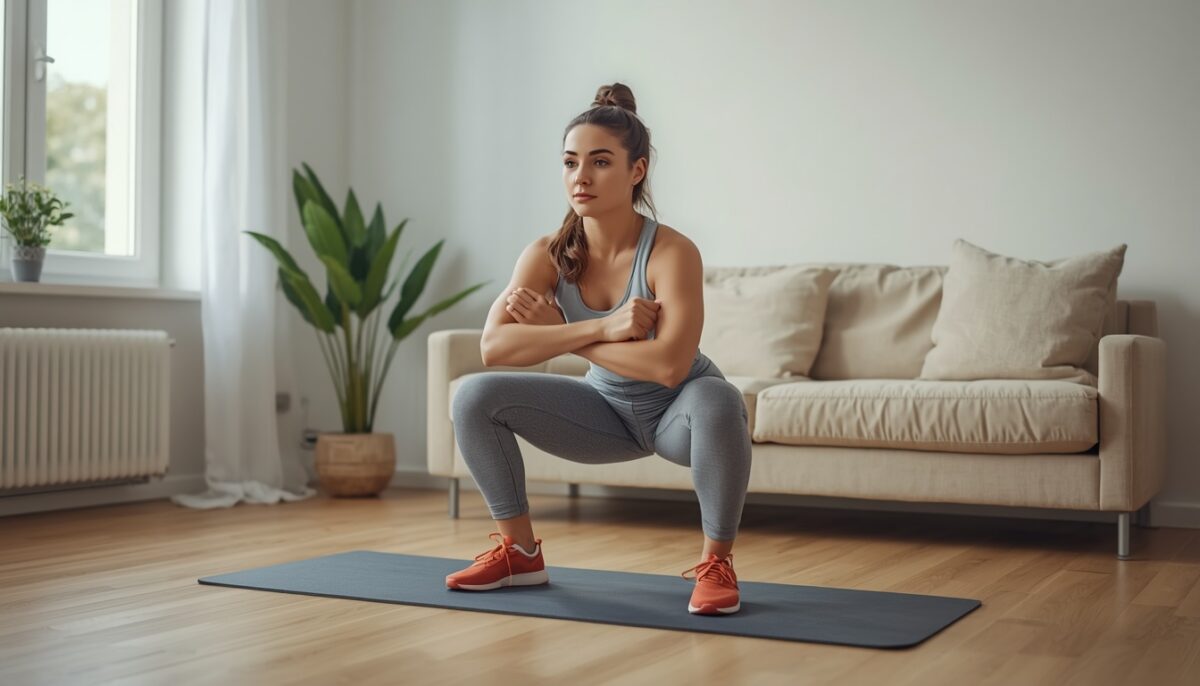
The first workout of the week introduces your body to several basic movement patterns. The goal is not to exercise as hard as possible. Instead, concentrate on controlled movements and good technique.
Before starting the main exercises, spend about five minutes warming up. You can walk around the room, march in place, move your arms gently, and perform a few easy bodyweight movements.
For the first few weeks, complete 2 sets of each exercise. Rest for approximately 45–60 seconds between sets.
Bodyweight Squats
Bodyweight squats are one of the simplest exercises for training the lower body.
Stand with your feet approximately shoulder-width apart. Keep your chest comfortably upright and slowly bend your knees and hips, lowering your body as far as you can do comfortably while maintaining control.
Then push through your feet and return to the starting position.
Beginner target: 8–12 repetitions
If regular squats feel difficult, use a sturdy chair behind you. Lower yourself toward the chair and lightly touch it before standing again.
Do not rush the movement. A controlled squat is more useful than performing many repetitions with poor technique.
Wall Push-Ups
Wall push-ups are a beginner-friendly way to work the chest, shoulders, and arms.
Stand facing a wall and place your hands against it at approximately chest height. Walk your feet slightly backward.
Bend your elbows and slowly bring your upper body toward the wall. Then push yourself back to the starting position.
Beginner target: 8–12 repetitions
As this movement becomes easier, you can gradually move your feet farther away from the wall.
If you later become comfortable with wall push-ups, you can progress to incline push-ups using a stable elevated surface.
Glute Bridges
Glute bridges focus on the muscles around your hips and buttocks while also involving the back of the legs.
Lie on your back with your knees bent and your feet flat on the floor.
Keep your arms comfortably beside your body. Press your feet into the floor and gently raise your hips.
Pause briefly at the top, then lower your hips in a controlled manner.
Beginner target: 10–15 repetitions
There is no need to lift your hips as high as possible. Focus on a comfortable range of motion and controlled movement.
Bird-Dog
The bird-dog is a useful beginner exercise for practicing balance, coordination, and controlled core movement.
Start on your hands and knees. Keep your back in a comfortable neutral position.
Slowly extend one arm and the opposite leg. Hold the position briefly, then return to the starting position and switch sides.
Beginner target: 6–8 repetitions per side
Move slowly rather than trying to extend your arm and leg as far as possible.
If maintaining balance is difficult, begin by moving only one arm or one leg at a time.
Standing Calf Raises
Calf raises are simple and can be performed almost anywhere.
Stand upright with your feet about hip-width apart. Hold onto a wall or sturdy chair if you need additional balance.
Slowly raise your heels so that you are standing on the balls of your feet. Pause briefly, then lower your heels.
Beginner target: 10–15 repetitions
Keep the movement controlled and avoid bouncing.
Day 1 Example
Your first workout could therefore look like this:
| Exercise | Sets | Repetitions |
|---|---|---|
| Bodyweight squats | 2 | 8–12 |
| Wall push-ups | 2 | 8–12 |
| Glute bridges | 2 | 10–15 |
| Bird-dog | 2 | 6–8 per side |
| Standing calf raises | 2 | 10–15 |
After completing the exercises, spend a few minutes walking slowly around the room and allowing your breathing to return to normal.
You do not need to add more exercises simply because you have finished the routine quickly.
For a beginner, completing the planned workout consistently is more important than constantly adding volume.
Day 2 – Lower Body and Core
After the first workout, you have a rest day.
You can use this day for normal daily activities or an easy walk if you feel comfortable. The purpose is to give your body time to recover before the second training session.
On Day 2, the emphasis shifts toward the lower body and core.
Start with another short warm-up before moving into the main exercises.
Sit-to-Stand
Sit-to-stand exercises are particularly practical for beginners because they use a movement you already perform in everyday life.
Sit on a sturdy chair with your feet placed firmly on the floor.
Lean forward slightly and stand up under control. Then slowly lower yourself back onto the chair.
Beginner target: 8–12 repetitions
Try not to drop heavily onto the chair.
If the movement is difficult, use your hands for light assistance when necessary. As you become stronger, aim to perform the movement with less assistance.
Reverse Lunges or Supported Lunges
Lunges can be challenging when you are new to exercise, so there is no need to perform a deep lunge immediately.
Stand near a wall or sturdy support.
Step one foot backward and gently lower your body as far as is comfortable. Push through the front foot to return to the starting position.
Alternate sides.
Beginner target: 6–8 repetitions per side
If reverse lunges are too difficult, perform a smaller movement or continue with sit-to-stand exercises instead.
The goal is controlled movement, not maximum depth.
Glute Bridges
Glute bridges appear again because repeating a basic movement can help beginners become familiar with proper technique.
Perform:
2 sets of 10–15 repetitions
If you find the exercise significantly harder on Day 2 than on Day 1, reduce the number of repetitions rather than forcing yourself to complete the original target.
Dead Bug – Beginner Version
The dead bug can help you practice controlled core movement.
Lie on your back with your knees bent and your feet on the floor.
Brace your abdominal muscles gently. Slowly lower one foot toward the floor while keeping the rest of your body controlled. Return it to the starting position and alternate sides.
Beginner target: 6–8 repetitions per side
You do not need to move your leg very far. The important part is maintaining control.
If this movement feels uncomfortable or difficult to coordinate, continue with bird-dog exercises instead.
Standing Knee Raises
Standing knee raises are an easy way to introduce controlled hip movement while also challenging balance.
Stand upright near a wall or sturdy chair.
Slowly lift one knee toward your comfortable range, lower it, and then repeat on the other side.
Beginner target: 8–10 repetitions per side
Use the support if you need it.
There is no requirement to lift your knee particularly high. A controlled movement is the priority.
Day 2 Example
| Exercise | Sets | Repetitions |
|---|---|---|
| Sit-to-stand | 2 | 8–12 |
| Supported reverse lunges | 2 | 6–8 per side |
| Glute bridges | 2 | 10–15 |
| Beginner dead bug | 2 | 6–8 per side |
| Standing knee raises | 2 | 8–10 per side |
This workout should remain manageable.
You should finish feeling that you have exercised, but you do not need to completely exhaust yourself.
How to Adjust the Exercises to Your Fitness Level
Not every beginner starts from the same fitness level.
One person may be able to perform 12 squats comfortably, while another may find six repetitions challenging. Both situations are normal.
Instead of comparing your numbers with someone else’s, use the exercises as a starting point.
If an exercise is too difficult:
- reduce the number of repetitions
- use a wall or chair for support
- shorten the range of motion
- take a longer rest
- choose the easier variation
If an exercise feels very easy:
- perform the movement more slowly
- add a few repetitions
- increase from one to two sets
- progress to a slightly more challenging variation
Make changes gradually.
The purpose of a 3-day home workout plan for beginners is to establish a foundation that can be developed over time.
You can also use our Best Home Workout Without Equipment (Complete Beginner Guide) if you want additional bodyweight exercise ideas.
Day 3 – Full-Body Beginner Workout
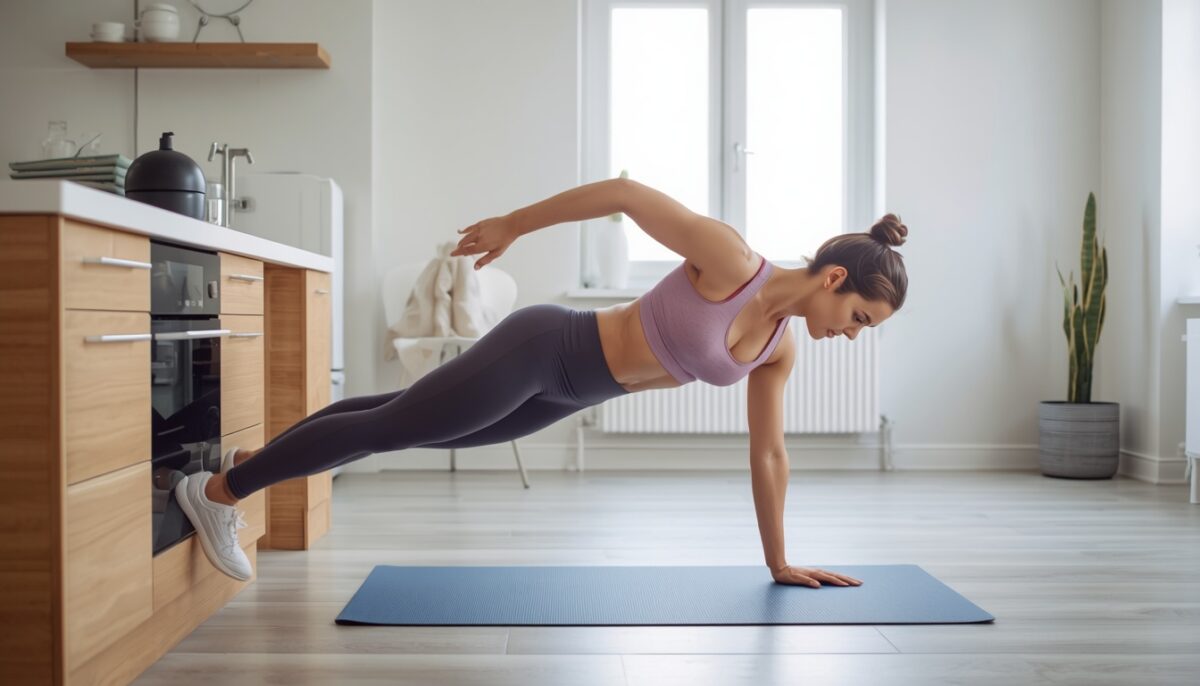
The third workout brings the week together with another full-body session. By this point, you have already completed two workouts, so the goal is to reinforce the basic movements without making the session unnecessarily difficult.
Start with a short warm-up and then complete 2 sets of each exercise, resting approximately 45–60 seconds between sets.
Incline Push-Ups
Use a stable elevated surface such as a sturdy table or countertop.
Place your hands on the surface slightly wider than your shoulders. Walk your feet backward and keep your body in a straight, comfortable position.
Bend your elbows and slowly lower your chest toward the surface. Push back to the starting position.
Beginner target: 8–12 repetitions
If this version is too difficult, return to wall push-ups. If it becomes easy, gradually use a lower surface.
Bodyweight Squats
Perform another set of controlled bodyweight squats.
Beginner target: 8–12 repetitions
Focus on the same technique you practiced during Day 1 rather than trying to increase the number of repetitions simply because it is the third workout of the week.
Alternating Reverse Lunges
Stand upright and step one foot backward. Lower yourself slightly, then return to the starting position.
Alternate legs.
Beginner target: 6–8 repetitions per side
Use a wall or chair for support if necessary.
Bird-Dog
Return to the hands-and-knees position and perform controlled bird-dog repetitions.
Beginner target: 6–8 repetitions per side
Move slowly and maintain balance throughout the exercise.
Standing Calf Raises
Finish the main workout with controlled calf raises.
Beginner target: 10–15 repetitions
Use a wall for balance if necessary.
Day 3 Example
| Exercise | Sets | Repetitions |
|---|---|---|
| Incline push-ups | 2 | 8–12 |
| Bodyweight squats | 2 | 8–12 |
| Reverse lunges | 2 | 6–8 per side |
| Bird-dog | 2 | 6–8 per side |
| Standing calf raises | 2 | 10–15 |
After the workout, spend a few minutes cooling down. Slow walking and gentle movements can help you transition back to your normal activities.
How to Progress From Week to Week
You do not need to completely change your workout every week.
For beginners, repeating the same basic exercises can be useful because it allows you to become more familiar with the movements and notice gradual improvements.
During the first week, concentrate mainly on learning the exercises.
During the following weeks, you can make small changes.
For example, you might:
- add one or two repetitions
- perform an exercise more slowly
- increase from two sets to three sets
- use a slightly more difficult variation
- reduce your rest period slightly
- improve your range of motion
Make only one or two changes at a time.
If you suddenly increase repetitions, sets, exercise difficulty, and workout duration simultaneously, it can become difficult to determine whether the new workload is appropriate for you.
A simple progression could look like this:
Week 1: Learn the movements and complete two sets.
Week 2: Try to add a few repetitions where comfortable.
Week 3: Continue increasing repetitions or improve your technique.
Week 4: Consider adding a third set to selected exercises if the workouts feel manageable.
There is no requirement to progress every week.
If a particular week feels difficult, simply repeat the same level until you feel ready to move forward.
What to Do on Rest Days
Rest days are part of your workout plan rather than wasted days.
On Tuesday and Thursday, you can continue with your normal daily activities. An easy walk can also be a good way to remain active if you feel comfortable.
Saturday can be used for optional light activity, while Sunday can be a complete rest day.
The important thing is not to turn every rest day into another demanding workout.
Your goal is to arrive at the next training session feeling reasonably recovered.
If you are interested in creating a broader weekly routine, our Weekly Home Workout Plan for Beginners provides another way to organize your exercise week.
Common Mistakes Beginners Should Avoid
A simple workout plan can become much less effective when beginners try to progress too quickly.
Doing Too Much Too Soon
Starting with long workouts every day may seem productive, but it can make the routine difficult to maintain.
Three structured workouts per week are enough to establish a regular exercise habit.
Ignoring Technique
Completing more repetitions is not the main goal.
Controlled movement and learning the basic exercise patterns should come first.
Skipping Rest Days
Rest is an important part of a sustainable exercise routine.
If your body needs additional recovery, give yourself more time rather than forcing yourself to follow the schedule exactly.
Comparing Yourself With Others
Fitness levels vary considerably.
Someone else may be able to perform more repetitions, use heavier weights, or exercise for longer. That does not mean you need to match them.
Measure your progress against your own starting point.
Changing the Plan Constantly
Beginners sometimes search for a new workout every few days.
This can make it difficult to determine whether a routine is actually helping.
Stick with the basic structure long enough to become comfortable with the exercises before making major changes.
How Long Should You Follow This Plan?
You can use this routine for several weeks while gradually becoming more comfortable with the exercises.
There is no fixed requirement to replace it after a particular number of weeks.
If the exercises remain appropriately challenging and you are continuing to improve, you can keep using the basic structure while making gradual progress.
Eventually, you may want to introduce resistance bands, dumbbells, or more advanced bodyweight exercises.
When that happens, the three-day structure can remain the same even though the individual exercises become more challenging.
The important thing is that your workout routine develops with your fitness level rather than changing simply for the sake of variety.
Frequently Asked Questions
Is a 3-day home workout enough for beginners?
Three structured workouts per week can provide a practical starting point for someone who is new to exercise. The most important factor is creating a routine that you can perform consistently.
Can I do this workout without equipment?
Yes. The basic routine is designed around bodyweight exercises and simple movements that can be performed at home. A chair or wall can be useful for support and exercise modifications.
What if I miss one workout?
Do not try to compensate by performing two demanding workouts on the same day. Simply continue with the next planned session when possible.
Missing one workout does not erase your progress.
Should I exercise on the days between workouts?
You can remain active on rest days with normal daily movement or an easy walk if you feel comfortable. You do not need to perform another demanding workout.
What if the exercises are too difficult?
Use an easier variation, reduce repetitions, or take longer rest periods.
For example, regular push-ups can be replaced with wall push-ups, while lunges can be performed with support and a smaller range of motion.
What if the workouts become too easy?
Gradually increase repetitions, add a set, slow down the movement, or progress to a more challenging variation.
Avoid making several major changes at once.
Final Thoughts
A 3-day home workout plan for beginners can give you a simple structure for becoming more active without requiring daily workouts or a gym membership.
The basic weekly schedule is straightforward:
Monday – Full body
Wednesday – Lower body and core
Friday – Full body
The days between workouts provide opportunities for recovery and normal daily activity.
Start with manageable exercises, concentrate on technique, and increase the difficulty gradually as your fitness improves.
You do not need to make every workout exhausting. A routine that you can repeat consistently is more useful than an ambitious plan that becomes difficult to maintain.
If you are just beginning your fitness journey, you can also return to our Home Workouts for Beginners: Complete Guide to Getting Started for the basic principles of creating a sustainable home exercise routine.
Pingback: Weekly Home Workout Plan for Beginners | Simple Guide
Pingback: Upper Body Home Workout for Beginners | Simple Guide